Algorithmic worlds
Portfolio |
- |
Information |
- |
Blog |
- |
Prints |
- |
Links |
About algorithmic worlds
IntroductionAlgorithmic art
Pictorial algorithms
Ultra Fractal
Algorithmic worlds
Piling patterns
The structure
Pattern generators
Index operators
The piling operator
An example
Other modules
Colored tilings
A simple way to produce geometric patterns covering the plane is to take any tiling and color each tile uniformly.
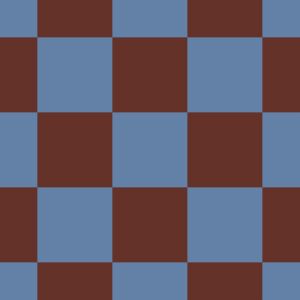
For instance, one can choose the color (or more precisely, in the case of algorithms implemented for Ultra Fractal, the index) randomly. 20060921 is a work using a randomly colored regular square tiling.
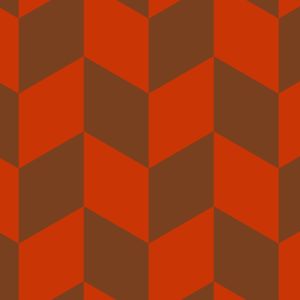
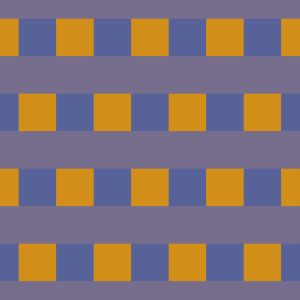
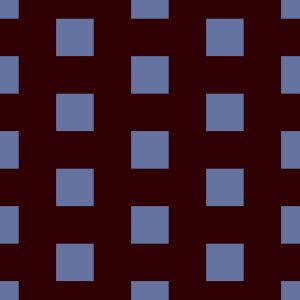
There is of course an infinite number of ways to color any tiling. If we restrict ourselves to the three regular tilings of the plane, there is an interesting class of colorings, namely the "uniform" coloring. The latter are defined by the property that around each vertex of the tiling, the tiles are colored in the same way. More precisely, given a vertex, there is an isometry of the tiling which maps any vertex onto it, matching the colors of the neighbouring tiles. (This definition actually makes sense for any uniform tiling.) See the wikipedia links for examples.
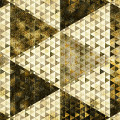
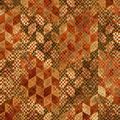
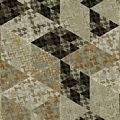
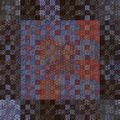
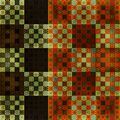
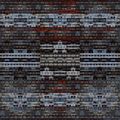
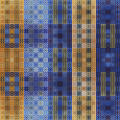
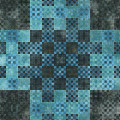
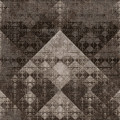
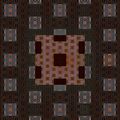
Uniform colorings of regular tilings are simple patterns which are well suited for pattern piling. Here are a few examples. On the left side, a uniform coloring of a regular tiling. On the right, the finished work obtained after piling (click on it for a zoomable version).
 |

 |
 |
 |
 |
 |
 |
 |
 |
 |
 |
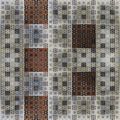 |
Note that the piling procedure admits adjustable parameters, such as the magnification step and the shift, what explains why the structures obtained after piling from a single pattern can be so different. See also these two related blog posts: Stars from squares, Piling hexagons. The second one presents a colored hexagonal tiling.
| Copyright S.Monnier 2009-2026. | . |