|
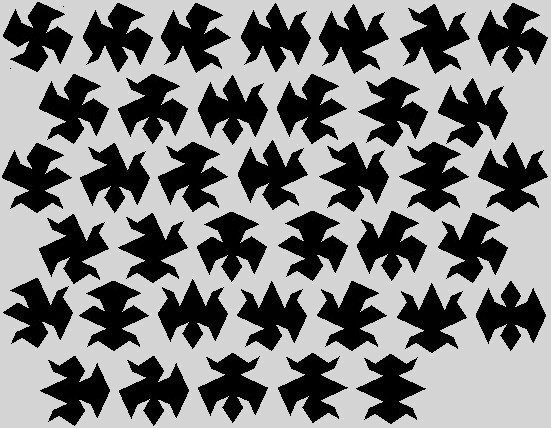
20000701
2000, digital image and limited edition of 20 archival pigment printsBack to the index
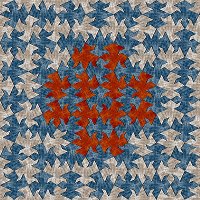
This image shows an very simple way of producing a non-periodic tiling.
Most of the tilings usually encountered are periodic,
which mean that a small part of the tiling can copied and regulary arranged
to recompose the original tiling. In the example below, the complete tiling can
be obtained by "cutting" the inside of the red square and laying it along
the blue gird.
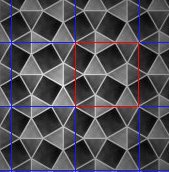
However, if you observe closely 20000701, you'll have trouble finding any periodicity. The tiles looks more or less similar, but are different. Even if you find two identical tiles, their respective neighbours will not correspond. How can we produce such a strange tiling ?
First we start with a standard checkerboard tiling (below, to the left). Then, imaging
we replace the straight and rather uninteresting side of each square with
a broken line, as shown below to the right.
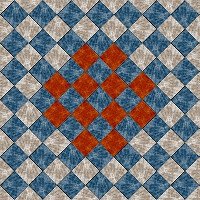 |  |
If replace them all in the same way, we should obtain something like the left image below.
However, it's much more interesting to choose their left-right and top-bottom
orientations randomly. This give the tiles a "similar but different" look
and since the broken lines are oriented randomly, no periodicity appears
(below, on the right).
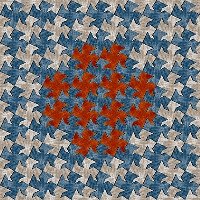 |  |
Each tile has four side, each of which can take four different configurations
(provided the broken line has no symetry, as above). So we have 44
= 256 possibilities. However, if we consider that two tiles that differs
only by a rotation or a symetry as equal, there remains 38 different tiles
as shown below. It's much more than one can imagine seeing the original
image...
20000701 counts about 100 tiles, so there are on average only three
tiles of each type.