Algorithmic worlds
Portfolio |
- |
Information |
- |
Blog |
- |
Prints |
- |
Links |
About algorithmic worlds
IntroductionAlgorithmic art
Pictorial algorithms
Ultra Fractal
Algorithmic worlds
Piling patterns
The structure
Pattern generators
Index operators
The piling operator
An example
Other modules
Discretization
This very simple operator turns
a continuous index into a locally constant index (a step
function). As a result it produces uniformly colored regions bounded by
curves of constant index. Here is the pattern produced by the "Perlin
noise" pattern generator (the various colors correspond to various
values of the index).
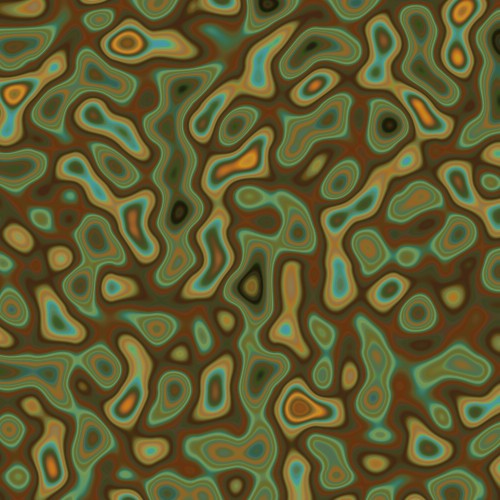
This pattern generator produces a continuous index (because in the
picture above, the colors vary smoothly). Applying the index operator
"Discretization", we get something like this:

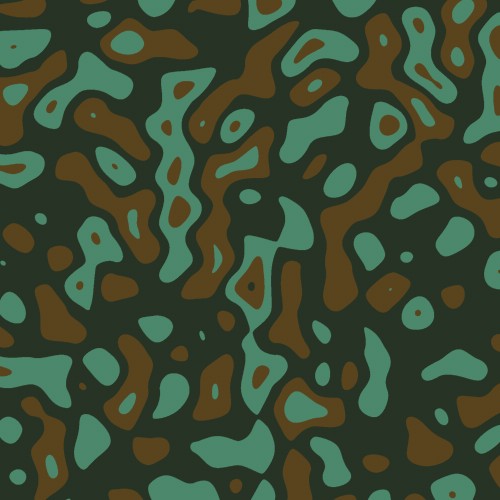
There are now only two colors, filling regions bounded by curves
of constant index value. It is interesting to vary the frequency at
which the colors switch, as well as the number of colors. In the image
below, we used a lower frequency and three colors.
Discretization turns out to be the most important index operator artistically speaking. It allows to produce strong structures which shape the image. Almost all of my work use discretization.
It is instructive to compare the effect of the discretization on a
piled pattern. Here is the piled Perlin Noise, it is a famous fractal,
the fractionnal Brownian motion.
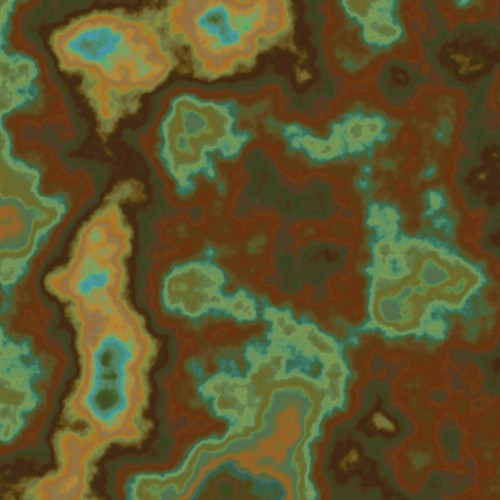
These cloudy shapes are great
for texturing, but in general too soft to provide a real "subject" for
an artwork. Now let us apply a discretization before piling the pattern.

It does not yet qualify as an artwork, but still, the intersecting curves do provide an interesting material to work on.
| Copyright S.Monnier 2009-2026. | . |