Algorithmic worlds
Portfolio |
- |
Information |
- |
Blog |
- |
Prints |
- |
Links |
About algorithmic worlds
IntroductionAlgorithmic art
Pictorial algorithms
Ultra Fractal
Algorithmic worlds
Piling patterns
The structure
Pattern generators
Index operators
The piling operator
An example
Other modules
Perlin noise
This pattern appeared originally around 1983 in an algorithme by Ken Perlin whose aim was to draw fractional Brownian motion. This cloudy pattern (see the image below) has numerous applictions in computer graphics and video games.

Fractional Brownian motion |
To draw it efficiently, Perlin had the idea to sum multiples copies of a simple pattern, each copy being rescaled by a factor 2 with respect to the previous one. To get a result close to the true fractional Brownian motion, the pattern to be summed must be chosen carefully. The pattern Perlin came up with is called Perlin noise.
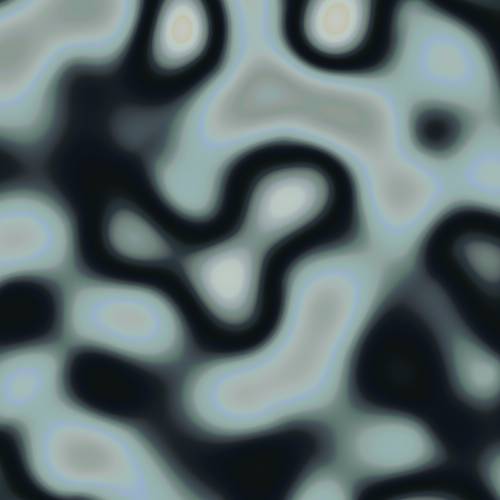
Perlin noise |
Perlin noise is drawn by choosing random vectors on the vertice of a square gird. It is then required to have these random vectors as gradient and is interpolated between the vertice of the gird to a continuous function. Here are more explanations.
The Perlin noise is artistically interesting because of its smooth and organic shapes. They become more obvious after a discretization index operator has been applied.
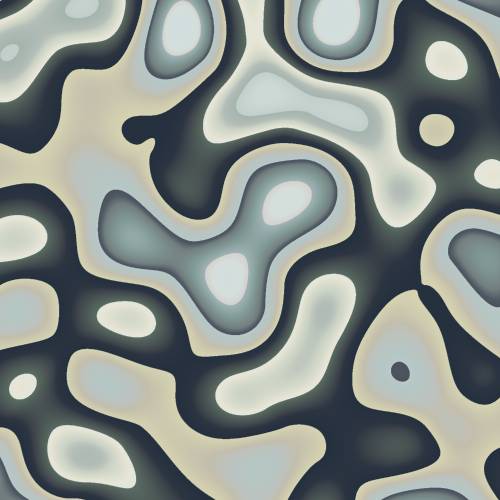
Perlin noise, after the application of a discretization index operator. |
By varying the interpolation between the vertice of the gird, one can get interesting variations:
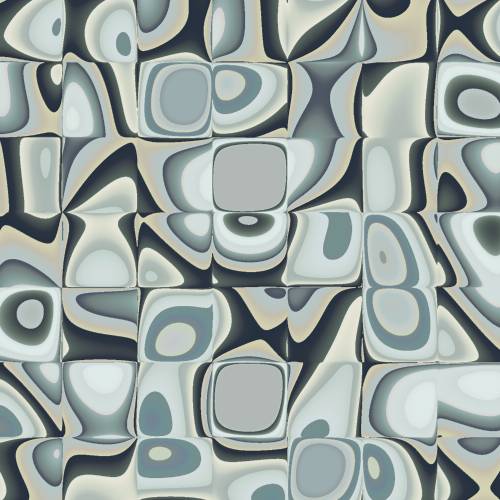
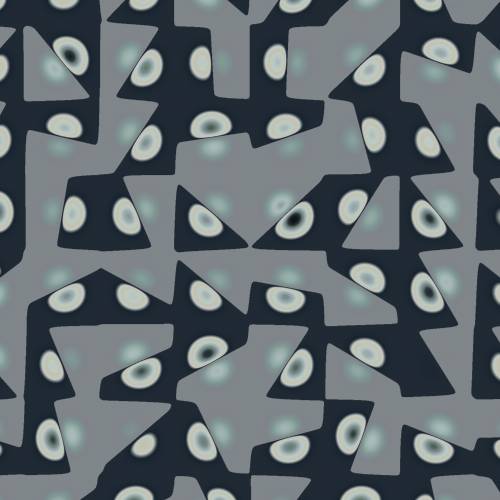


Here are
some images using Perlin noise as basic pattern. Be sure to explore
this gigapixel image, which is based on Perlin noise as well.
| Copyright S.Monnier 2009-2026. | . |