 |
20090603-1
2009, digital image and unique archival pigment printBack to the index
A blog post related to this work:
June 4th 2009
Piling hexagons
As I tried to explain here, all of my images are constructed by piling simple
patterns. Piling patterns is a truely addictive activity. It's impossible to
predict what you will get and, provided the pattern is simple enough, the result
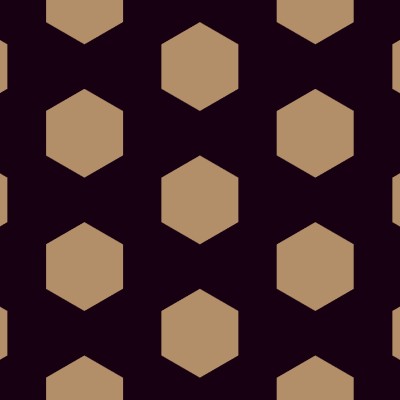
is bound to be esthetically pleasant. Consider for instance the hexagonal tiling
by black and brownish hexagons shown below.
|
The hexagons are colored such that around each vertice of the tiling, there are
always two black hexagons and a brown one. Such a coloring is called Archimedean.
For those understanding these words, this coloring is even uniform, because the
symmetry group of the colored tiling acts transitively on the vertices. Anyway,
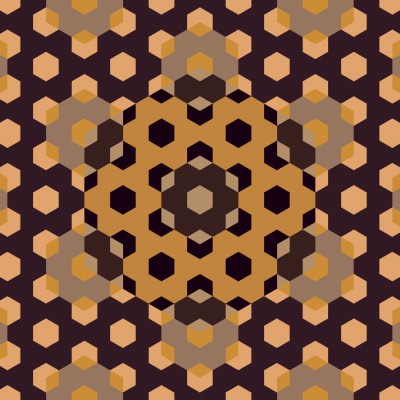
it is a desperately simple pattern. Let us see what happen when we pile several
copies of it, each copy being three times smaller than the previous one. Adding
three copies, we get these nice shapes.
|
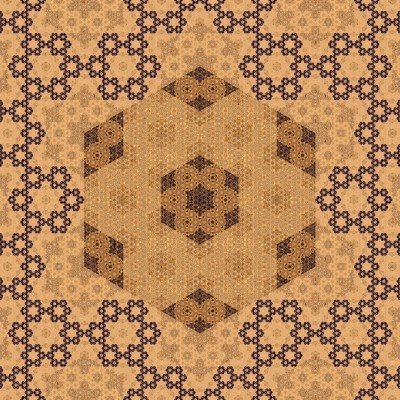
Going on and adding enough copies so that the smallest ones cannot be
distinguished anymore, we get this :
|
Among other things, one can spot Koch snowflakes ! Even better, a closer look reveals a tiling of the plane by Koch snowflakes. Actually, the procedure consisting of removing from the plane the (open) brown hexagons from each copies of the tiling results in a fractal subset of the plane (pictured in black in the image above) which is the boundary of the tiling of the plane by the Koch snowflakes. There are many tilings by Koch Snowflakes (see for instance here), but I counldn't find this one... I would guess that the boundary of this tiling can be generated as an iterated function system. Anyway, here is a polished image to explore.